
Exhibitions
Past Exhibitions
Teodoro González de León. 90th anniversary six-meter traversable cube
Teodoro González de León
Past Exhibition
29 September 2016 – 30 October 2016
Teodoro González de León (Mexico City, 1926 – 2016) together with Abraham Zabludovsky (Poland, 1924 – Mexico City, 2003), designed the Museo Tamayo and was without question one of the most notable and prolific figures in Mexican architecture in the second half of the twentieth century. Using form, volume, composition, rhythm and specific materials, such as bush- hammered concrete, he transformed the urban landscape of the country’s capital and many other cities. In parallel to his architectural work, he was also a painter and sculptor.
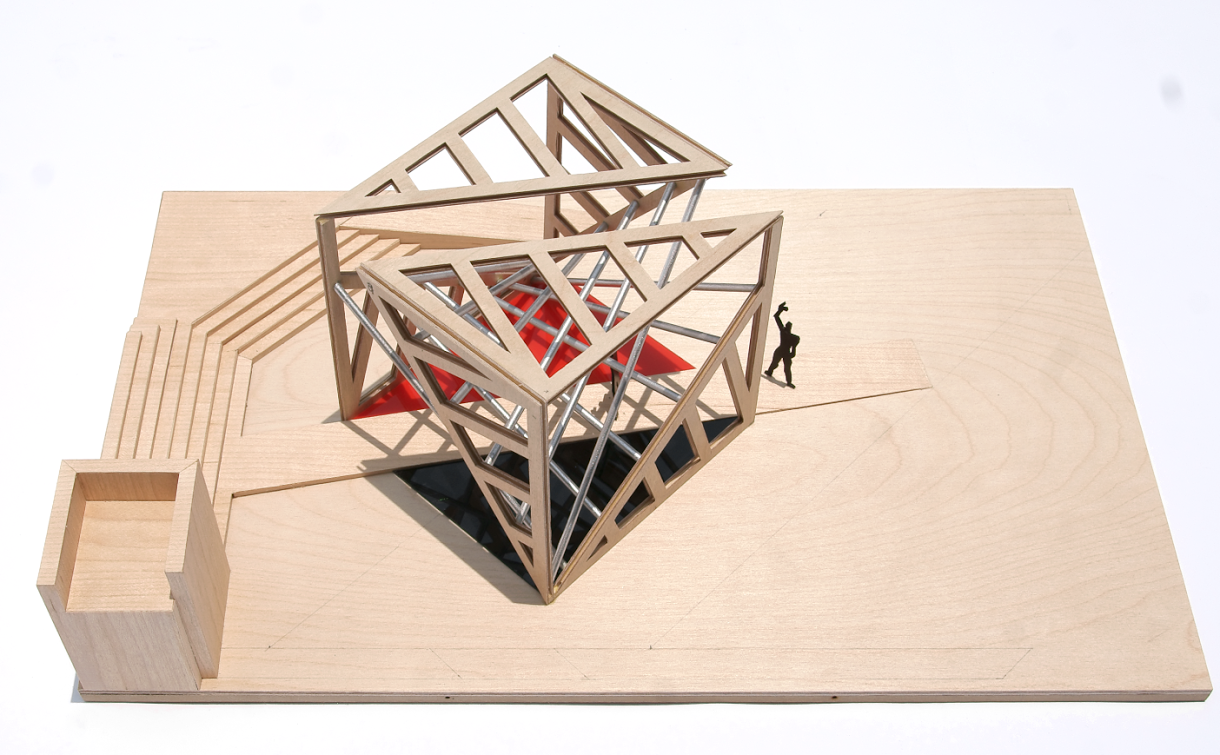
On the occasion of the 90th anniversary of the birth of Teodoro González de León, the Mexican Ministry of Culture through the National Fine Arts Institute, and in partnership with the Secretariat of Culture of Mexico City, present Six-meter traversable cube. Formed by six Egyptian triangles connected by 12 tubes, 2016, a temporary sculpture created for this occasion by González de León himself.
The Traversable cube is a sculpture comprising six Egyptian triangles linked by steel tubes supported at six corners, suggesting a hyperbolic paraboloid that generates the sensation of a tunnel when transited by the viewer. From an engineering and architectural point of view, the piece represents a challenge to design and construction. As the work’s creator himself put it, every architectural work is, when it comes down to it, “a sculpture or inhabitable structure open to transit, work, socializing, and visiting.”
It is an honor to celebrate a Mexican architect who, over a seventy-year career, continued to surprise us with his work right up to the end.
Image:
Six-meter traversable cube. Formed by six Egyptian triangles connected by 12 tubes
Teodoro González de León, in collaboration with Carlos Gutiérrez Juárez and José Arce Gargollo
Pine wood, steel tubes and plates, tempered glass